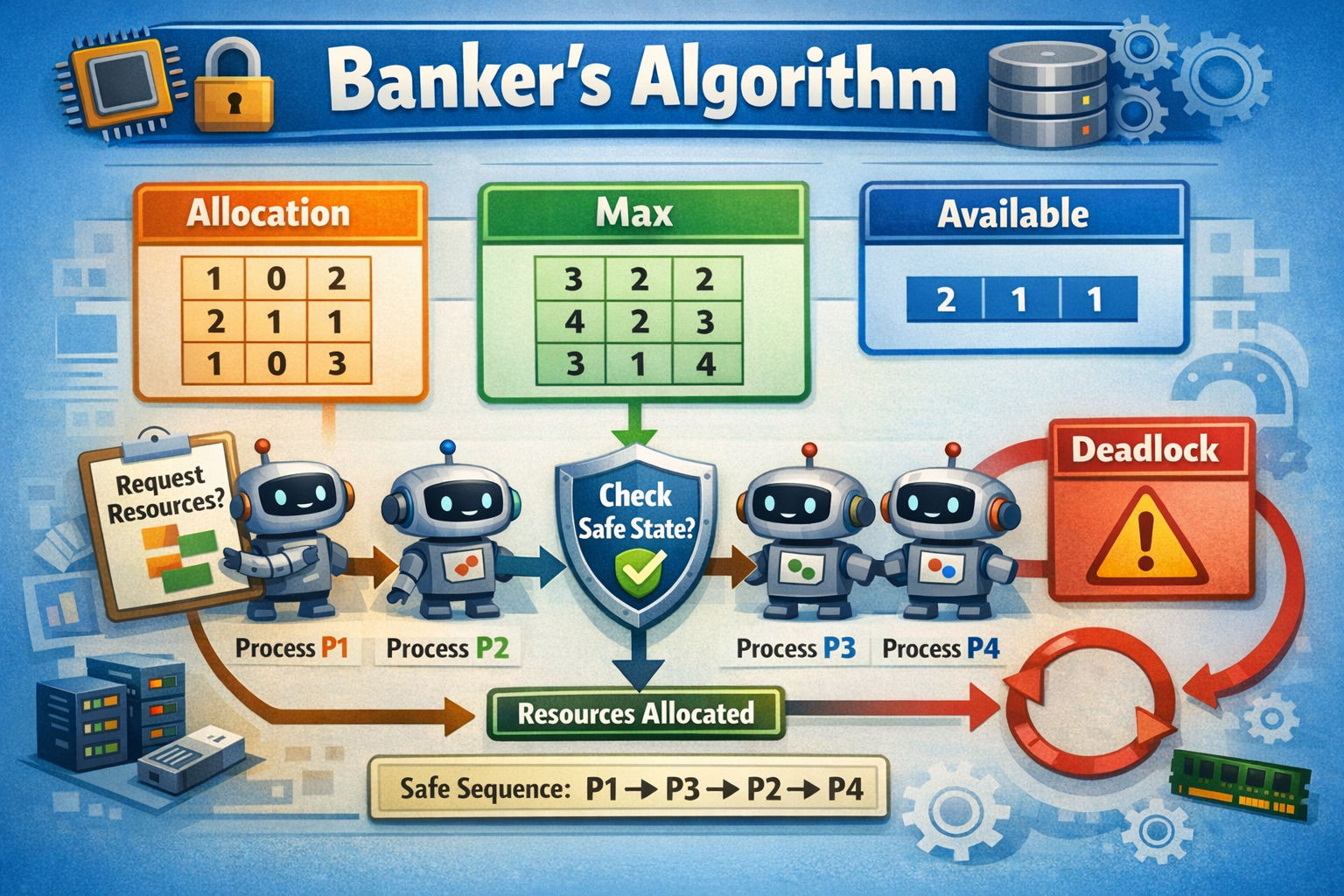
Imagine you are a bank manager. Your vault has a limited amount of cash, and several customers are lined up asking for loans. You could hand out money to everyone who walks in — but what happens if they all return at the same time demanding more, and your vault runs dry? Nobody gets paid. Everything freezes. The whole system collapses.
Operating systems face this exact crisis — every single second. Multiple processes run simultaneously, each demanding CPU time, memory, printers, and file access. If the OS blindly distributes resources without thinking ahead, the entire system can deadlock — and not a single process will ever finish.
This is precisely why the Banker's Algorithm was invented. It acts as the responsible bank manager of your OS — one that only approves a resource request when it can mathematically guarantee a safe future for every process in the system. In this guide, we break it all down — what it is, how it works, a fully solved example with tables, pseudocode, C code, and why it truly matters.
What is the Banker's Algorithm?
The Banker's Algorithm is a deadlock avoidance algorithm used by operating systems to safely manage resource allocation among competing processes. It was developed by the Dutch computer scientist Edsger W. Dijkstra in 1965, first described in the context of the THE multiprogramming system.
The name is directly inspired by the banking world. Just like a bank never lends more money than it can cover — ensuring every client can eventually be served — the OS uses this algorithm to ensure every process can eventually complete without running into a deadlock.
The core idea: before granting any resource request, the OS simulates the allocation and checks if the system would remain in a "safe state." If yes, the request is granted. If no, the process is made to wait until it is safe to proceed.
Why Do We Need the Banker's Algorithm?
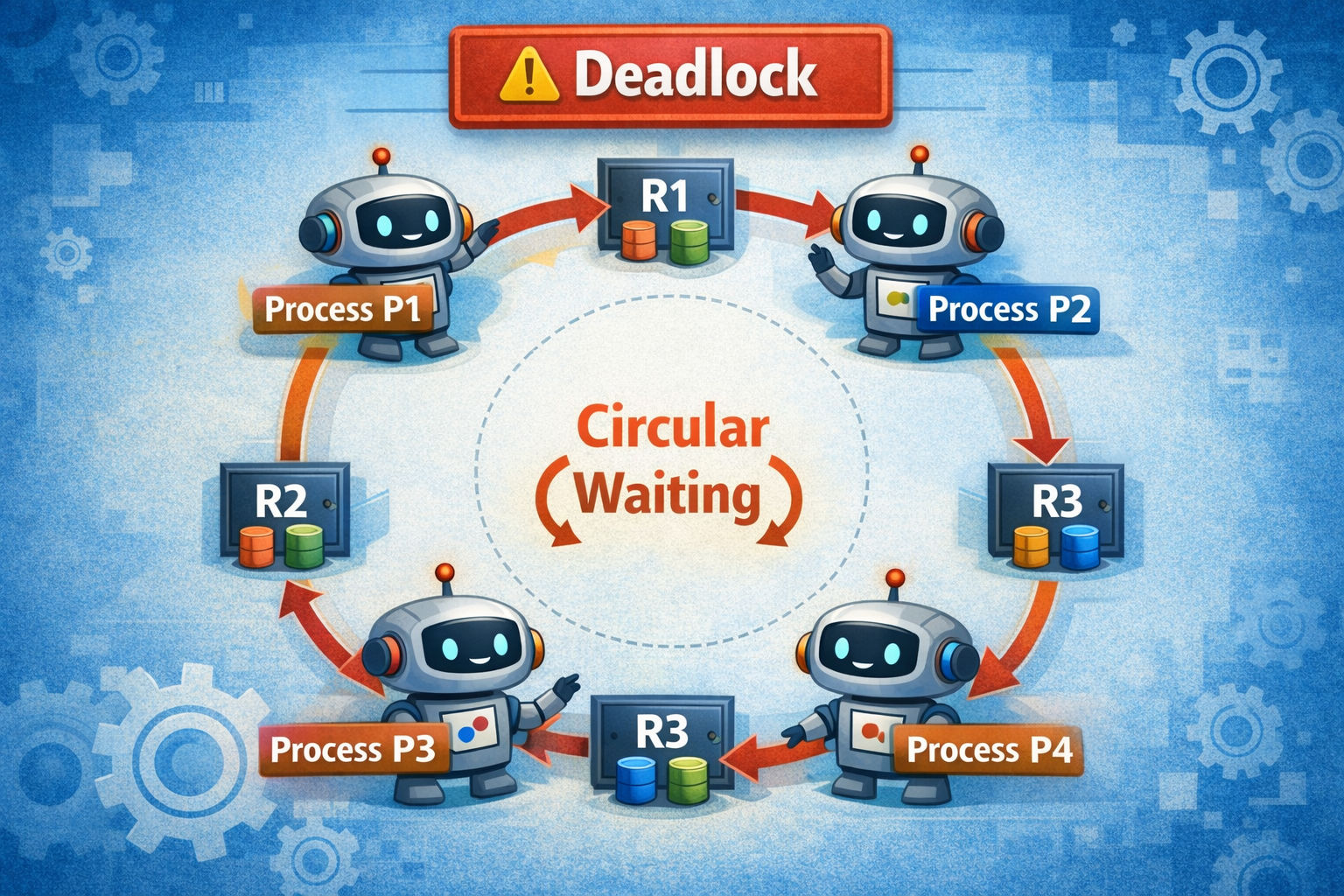
In any multitasking operating system, processes run concurrently and each needs resources — RAM, CPU, I/O devices, and more. These resources are finite. A deadlock occurs when processes are stuck in a circular wait, each holding a resource another needs, and none can ever proceed.
For example:
Process A holds Resource 1 and is waiting for Resource 2.
Process B holds Resource 2 and is waiting for Resource 1.
Neither can ever move forward. The system is permanently stuck.
There are four Coffman Conditions that must all hold for deadlock: mutual exclusion, hold and wait, no preemption, and circular wait. The Banker's Algorithm prevents the system from ever reaching a state where circular wait becomes inevitable.
❓ Frequently Asked Questions
What is the main purpose of the Banker's Algorithm?▼
The main purpose of the Banker's Algorithm is to prevent deadlocks in a system by ensuring that the system is always in a safe state.
How does the Banker's Algorithm work?▼
The Banker's Algorithm works by maintaining a table of available resources and a table of allocated resources, and simulating the allocation of resources to each process until it finds a safe sequence or until it finds that the system is unsafe.
What are the advantages of the Banker's Algorithm?▼
The advantages of the Banker's Algorithm include preventing deadlocks, allowing for efficient allocation of resources, and reducing the risk of starvation.
Can the Banker's Algorithm be used in real-world systems?▼
Yes, the Banker's Algorithm can be used in real-world systems, such as operating systems, to prevent deadlocks and ensure efficient allocation of resources.
Is the Banker's Algorithm a complex algorithm to implement?▼
🎓 Need Help With Your Project?
AcadKits provides ready-made engineering projects, custom development services, and free developer tools for students.
Before understanding how the algorithm works, you must know these five building blocks. Every Banker's Algorithm problem is built around them.
1. Available
A 1D vector that tells us how many resources of each type are currently free and unallocated. For example, if there are 3 resource types (A, B, C), Available = [3, 2, 2] means 3 units of A, 2 of B, and 2 of C are available right now.
2. Maximum
A 2D matrix. Each row represents a process, and each column a resource type. It defines the maximum number of resources a process could ever need during its entire lifetime. Processes declare this upfront.
3. Allocation
A 2D matrix showing how many resources of each type are currently held by each process at this moment in time.
4. Need
The most critical derived matrix. It represents how many more resources each process still requires to finish execution.
Formula: Need[i] = Maximum[i] − Allocation[i]
5. Safe State
A system is in a safe state if there exists at least one safe sequence — an order to run all processes such that each one eventually gets the resources it needs and finishes, freeing up resources for the next in line. If no such sequence exists, the system is in an unsafe state — not necessarily deadlocked, but at serious risk.
How the Banker's Algorithm Works — Step by Step
The algorithm has two parts that work together: the Safety Algorithm and the Resource-Request Algorithm.
Part 1 — Safety Algorithm (Pseudocode)
This checks whether the current system state is safe. Run this anytime you need to verify the state.
// Safety Algorithm — Pseudocode

1. Let Work  = Available          // copy of free resources
   Let Finish[i] = false          // no process finished yet

2. Find index i such that:
      Finish[i] == false
   AND Need[i] <= Work            // can we satisfy its needs?

   If no such i exists → go to step 4

3. Work   = Work + Allocation[i]  // process finishes, releases resources
   Finish[i] = true
   Go to step 2

4. If Finish[i] == true for ALL i → SAFE STATE ✓
   Else                           → UNSAFE STATE ✗
Part 2 — Resource-Request Algorithm (Pseudocode)
This runs every time a process makes a new resource request. It acts as the gatekeeper.
// Resource-Request Algorithm — Pseudocode
// Process Pi makes Request[i]

Step 1: if Request[i] > Need[i]
           → ERROR: process exceeded its maximum claim

Step 2: if Request[i] > Available
           → Pi must WAIT (not enough resources free)

Step 3: Pretend to allocate (temporary):
           Available       = Available - Request[i]
           Allocation[i]   = Allocation[i] + Request[i]
           Need[i]         = Need[i] - Request[i]

Step 4: Run Safety Algorithm on this new state

Step 5: if result is SAFE  → Grant the request permanently ✓
        if result is UNSAFE → Roll back step 3 changes, make Pi wait ✗
Implementation in C Language
Here is a clean C implementation of the Safety Algorithm — the heart of the Banker's Algorithm:
#include <stdio.h>
#include <stdbool.h>

#define P 5   // Number of processes
#define R 3   // Number of resource types

bool isSafe(int available[R], int allocation[P][R],
             int need[P][R]) {

    int  work[R];
    bool finish[P];

    // Step 1: Initializefor (int i = 0; i < R; i++)  work[i]   = available[i];
    for (int i = 0; i < P; i++)  finish[i] = false;

    int  safeSeq[P];
    int  count = 0;

    while (count < P) {
        bool found = false;

        for (int i = 0; i < P; i++) {
            if (!finish[i]) {
                bool canRun = true;

                // Check if Need[i] <= Workfor (int j = 0; j < R; j++) {
                    if (need[i][j] > work[j]) {
                        canRun = false;
                        break;
                    }
                }

                if (canRun) {
                    // Process finishes — release its resourcesfor (int j = 0; j < R; j++)
                        work[j] += allocation[i][j];

                    safeSeq[count++] = i;
                    finish[i]        = true;
                    found            = true;
                }
            }
        }

        // No process could run this round — unsafeif (!found) break;
    }

    if (count == P) {
        printf("System is in SAFE STATE.\nSafe Sequence: ");
        for (int i = 0; i < P; i++)
            printf("P%d%s", safeSeq[i], i < P-1 ? " → " : "\n");
        return true;
    }

    printf("System is in UNSAFE STATE.\n");
    return false;
}

int main() {
    int available[R]       = {3, 2, 2};

    int allocation[P][R]   = {
        {0, 1, 0},   // P0
        {2, 0, 0},   // P1
        {3, 0, 2},   // P2
        {2, 1, 1},   // P3
        {0, 0, 2}    // P4
    };

    int maximum[P][R]       = {
        {7, 5, 3},   // P0
        {3, 2, 2},   // P1
        {9, 0, 2},   // P2
        {2, 2, 2},   // P3
        {4, 3, 3}    // P4
    };

    int need[P][R];
    for (int i = 0; i < P; i++)
        for (int j = 0; j < R; j++)
            need[i][j] = maximum[i][j] - allocation[i][j];

    isSafe(available, allocation, need);
    return 0;
}

// Output:
System is in SAFE STATE.
Safe Sequence: P1 → P3 → P4 → P2 → P0
Complete Worked Example — Fully Solved
We have 5 processes (P0–P4) and 3 resource types: A, B, C with total instances A = 10, B = 5, C = 7.
✅ All processes finished. System is in SAFE STATE.
Safe Sequence: P1 → P3 → P4 → P2 → P0
Advantages and Disadvantages
✅ Advantages
No deadlocks: Followed strictly, deadlocks are completely avoided — not merely detected.
Better utilization than prevention: It allows more flexible resource use while staying safe.
Mathematically proven: The algorithm is formally correct — not a heuristic.
Fairness: Every process is eventually guaranteed to complete.
❌ Disadvantages
Requires maximum declaration upfront: Processes must state their peak needs before starting — often impractical in real systems.
Fixed number of processes and resources: New processes arriving mid-execution break the model.
Overhead: Safety check runs on every request — O(n² × m) time complexity. Expensive for large systems.
No preemption assumed: Resources cannot be forcibly taken back, limiting flexibility.
Not used in modern OS kernels: Linux, Windows, macOS use other strategies due to these practical constraints.
Banker's Algorithm vs Other Deadlock Strategies
FeaturePreventionAvoidance (Banker's)Detection & RecoveryWhen it actsBefore any allocationBefore each allocationAfter deadlock occursOverheadLowMedium–HighHigh (recovery cost)Resource utilizationLowMediumHighNeeds max declarationNoYesNoGuarantees no deadlockYes (strictly)Yes (dynamically)NoUsed in modern OSPartiallyRarelyMore commonly
Safe State vs Unsafe State — Cleared Up
A safe state does NOT mean every process gets resources instantly. It means there is some sequence where all processes will eventually complete — even if some must wait. Progress is guaranteed.
An unsafe state does NOT mean deadlock has already happened. It means the OS can no longer guarantee all processes will complete. Think of it like driving toward a cliff in fog — you haven't fallen yet, but the danger is real. The Banker's Algorithm stops the car before the cliff edge, even if there's a chance you might have made it.
That's why it's conservative by design — it denies requests that could lead to unsafe states, trading off some performance for complete safety.
Conclusion
The Banker's Algorithm is one of those rare computer science concepts that feels complex on paper but is completely intuitive once you see the analogy — a responsible bank manager who never lends more than the vault can support.
For CS students, understanding this algorithm isn't just about clearing an exam. It's about thinking like a systems designer — someone who doesn't just fix today's bug but anticipates tomorrow's failure before it happens. That proactive, defensive mindset is what separates good engineers from exceptional ones.
If this explanation helped you, explore our other posts on OS scheduling algorithms, memory management, and process synchronization — because in operating systems, every concept connects beautifully to the next.
The Banker's Algorithm can be complex to implement, especially in large systems, but it is a crucial concept in operating systems and is widely used in computer science.